
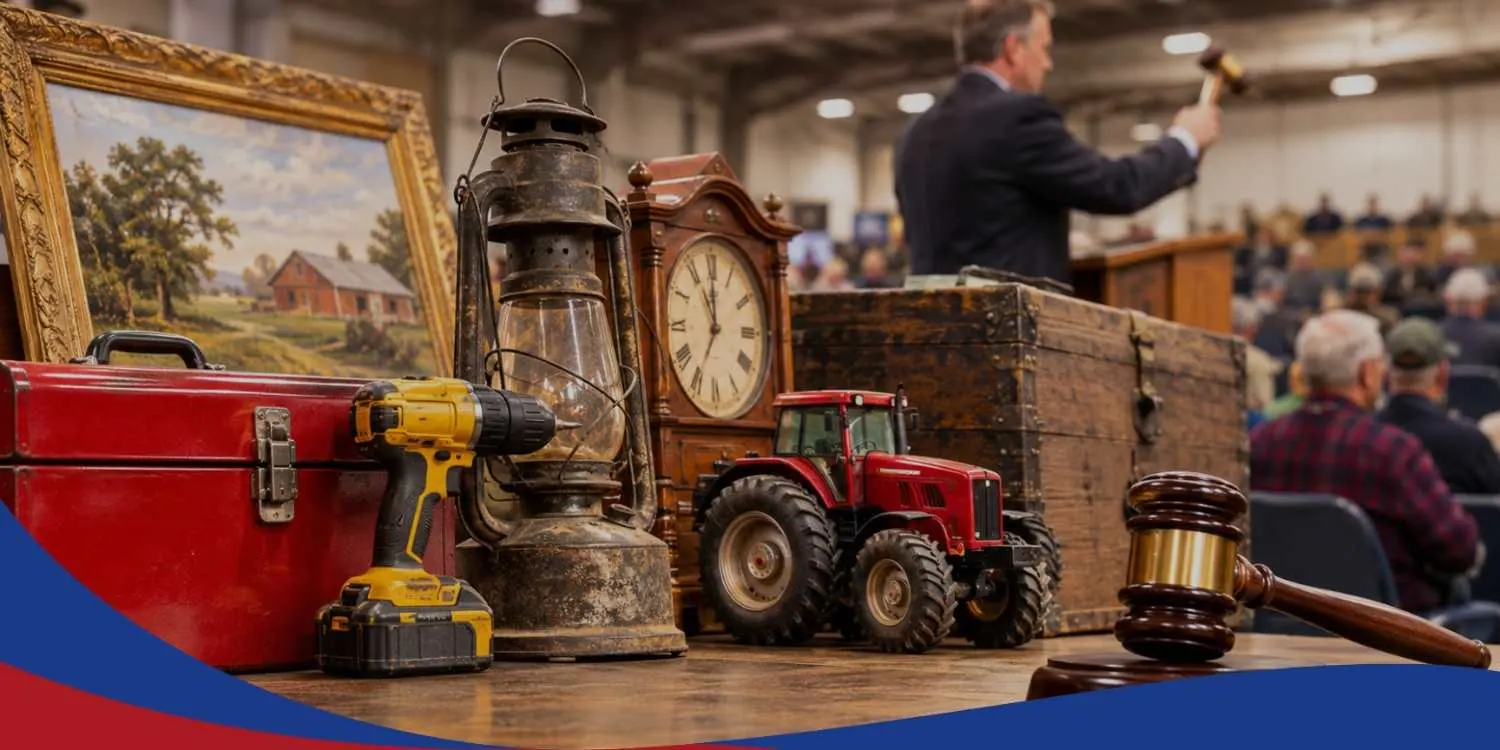
Picture a contractor staring at the trailer behind his shop: two old compressors, a stack of nail guns and a sawmill head he stopped using years ago. Listing each piece online means weeks of photos, lowball offers and buyers who never show up. Dropping the whole load at a consignment auction means one delivery, one sale day and one payout.
A consignment auction is a sale in which a professional auction house sells your items for you in exchange for a commission. You hand over the goods, the auctioneer sells them to the highest bidder, and you keep the proceeds minus that commission. You do not have to sell an entire estate or close a business to use one.
How does a consignment auction work? You consign your items, the auction house inspects, photographs, lists and promotes them, bidders compete on sale day, and you are paid after buyers settle up, less the auction’s commission. The next section walks through each step.
A consignment auction works best for people with anywhere from a handful to a few hundred sellable items who want market-driven prices without running the sale themselves. We cover who it suits, and who it doesn’t, further down.
How Does a Consignment Auction Work? Step by Step
A consignment auction follows the same basic path from your first call to the day the check arrives. Timelines vary by auction house, but the sequence is nearly always the same.
- Contact the auction house and submit a consignment form: You list what you have, with brand, model, condition and rough quantity. Many houses accept this form by email, and some will send someone to view larger lots.
- Get your items vetted: The auction team decides which items fit their buyers. Broken, incomplete or low-demand pieces may be declined, and that is a good thing: it keeps the sale strong for everyone.
- Agree on terms and sign the consignment agreement: This document sets the commission rate, any lot or entry fees, the reserve if one applies, and the payout schedule. Read it before you sign.
- Drop off or arrange pickup: Deliver items to the auction grounds or warehouse by the set deadline. Larger or heavier equipment may be collected for an added fee.
- Items are cataloged and photographed: Staff assign lot numbers, take photos, write descriptions and publish the catalog online and in print. Accurate descriptions matter, because buyers bid on what they can see and read.
- The auction promotes your sale: Good houses market to their existing bidder lists, trade publications and online platforms. This reach is the main thing you are paying for.
- Bidding happens on sale day: Buyers bid in person, online or both, and each lot goes to the highest bidder. If you set a reserve and bidding stays below it, the item is passed (not sold).
- Buyers pay and collect: The auction invoices buyers, which usually includes a buyer’s premium, and holds items until payment clears.
- You receive a settlement statement and payout: The auction deducts its commission and any fees from the sale prices, then sends you a statement listing each lot, its hammer price and your net. Payment typically follows within a few weeks.
- Unsold items are handled per your agreement: You can usually collect them, relist them in a later sale, or lower the reserve.
The key point, after drop-off, the auction house does the selling work, and you are paid only if and when your items sell.
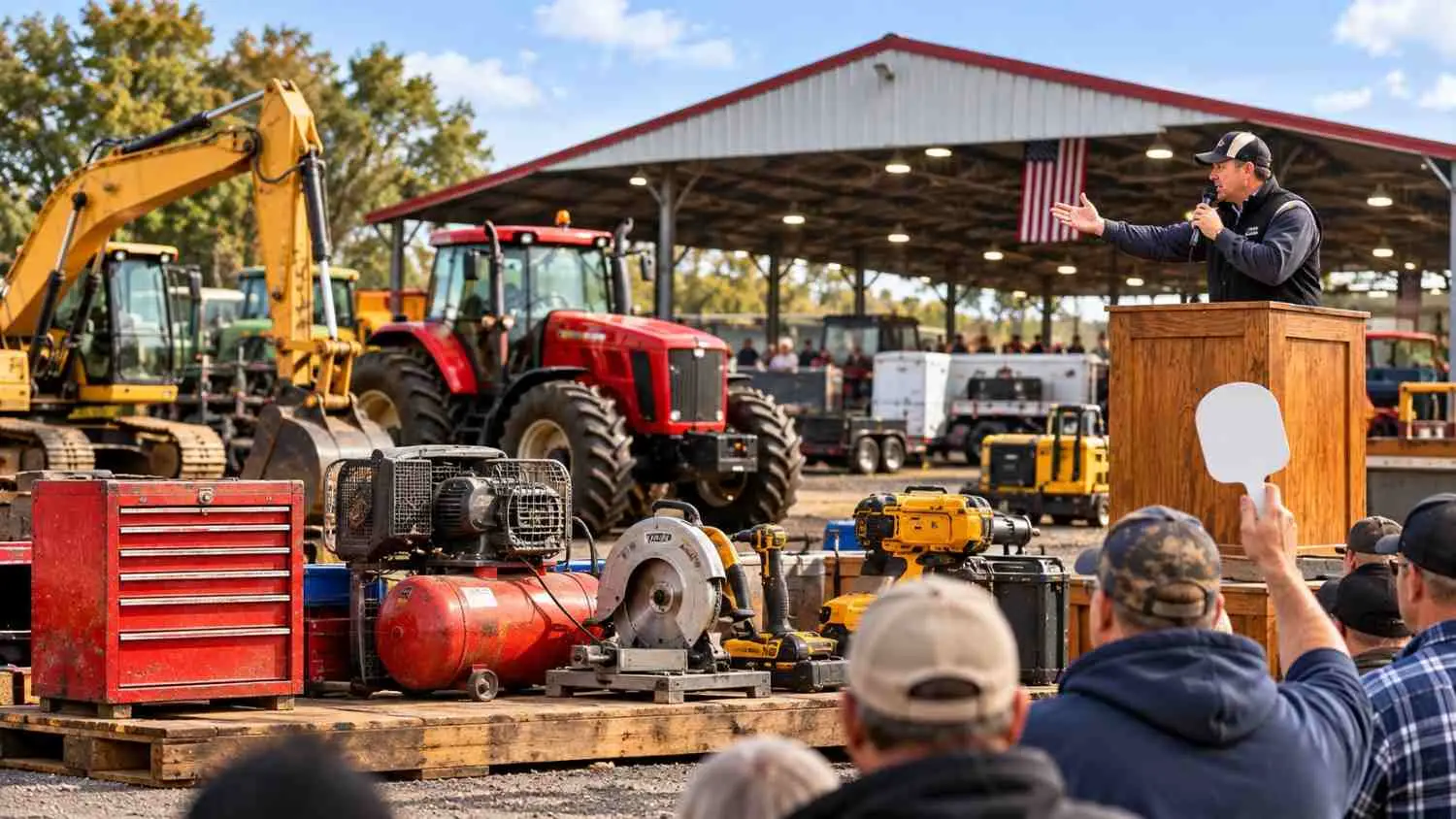
Air Works Consignment Auction Explained
“Air Works consignment auction” is a popular search because it names one of the best-known examples of the model in practice. It is an annual equipment and tool sale in Ohio, and it shows how consignment works at scale.
According to the event’s company profile, it began when Reuben Troyer, who ran an air tools and fasteners business, wanted a way to sell used rental equipment that newer models had replaced. The first sale was held in 1990, and it later outgrew its early venues and moved to Mt. Hope, Ohio, in 2015.
The 38th annual sale ran February 19 to 21, 2026, in Millersburg, Ohio, with bidding both onsite and online. The listing describes thousands of lots across categories such as heavy equipment, trucks and trailers, construction equipment, lifts, sawmill and woodworking equipment, metalworking tools, and antique and toy collections.
Here is how that fits the consignment model:
- Sellers consign by emailing a consignment form, and the organizers may ask for items to be brought to a warehouse or visit to photograph and catalog larger equipment.
- The auction handles marketing and runs the sale, with early consignments advertised at no extra charge.
- Buyers bid in person or online over a multi-day event.
For current dates, terms and commission, check the organizer’s website directly, since details change from year to year.
Who Should (and Shouldn’t) Use a Consignment Auction
Consignment auctions suit sellers with items that have a ready market and who value time over squeezing out every last dollar.
|
Good fit |
Poor fit |
|
|
Items |
Tools, equipment, vehicles, collectibles, antiques with active buyers |
Common household goods, damaged or incomplete items |
|
Volume |
A few valuable pieces up to several hundred lots |
One low-value item |
|
Timeline |
Flexible, with a fixed sale date you can plan around |
Need cash this week |
|
Price goal |
Fair market price set by competitive bidding | A guaranteed minimum, regardless of demand |
| Effort | Prefer to hand off photography, marketing and buyer handling |
Want full control over every listing and conversation |
Consignment Auction vs Other Options
Consignment suits selling some of your items; a full estate auction suits selling nearly everything; a private sale suits selling one item to one buyer.
|
Consignment auction |
Full estate auction | Private sale | |
|
Best for |
A selection of valuable items |
Entire estates, households or businesses |
A single high-value or unusual item |
|
Who runs the sale |
Auction house |
Auction house, often on your site |
You |
| Pricing | Set by bidders | Set by bidders |
Negotiated |
|
Speed |
Next scheduled sale, then payout | Sale date set after full cleanout planning |
Depends on finding a buyer |
|
Seller effort |
Low: deliver and sign | Low, but the whole estate is involved | High: photos, listings, messages, meetups |
| Cost | Commission, sometimes lot fees | Higher commission or flat fee, plus setup |
Platform fees, if any |
| Main risk | Items may sell below hopes or not at all | Strong and weak items are bundled in one event |
Slow sale, scams, no-shows |
Consignment Auctions Near Me: How to Choose Locally
Searching for consignment auctions near me usually turns up a mix of weekly sales, annual events and estate specialists, so it helps to narrow the field. Start with houses that sell the type of item you own, because a farm-equipment crowd will pay more for a tractor attachment than a general household sale will. Then confirm the auctioneer is licensed in Ohio under Chapter 4707 of the Ohio Revised Code, ask how far their bidder list reaches, and check whether you can drop items off close to home. A local auction with a loyal buyer base often beats a bigger sale three counties away once you count hauling time and fees.
What Sells Well, and What You’ll Net
Items with clear buyer demand and obvious condition do best. These categories consistently draw bids:
- Power tools, hand tools and shop equipment
- Construction and heavy equipment, plus attachments
- Trucks, trailers and utility vehicles
- Woodworking and metalworking machinery
- Antiques, coins, toys and other collectibles
- Clean, complete lots with working parts and photos that show real condition
Typical commission: Rates vary by auction house, item value and volume, so treat these figures as general ranges and confirm them in your agreement. Seller commissions commonly fall between roughly 10% and 30% of the hammer price, with lower rates for high-value equipment and higher rates for small items and mixed lots. Some houses add small entry or lot fees. Buyers usually pay a separate buyer’s premium, which does not come out of your proceeds.
What to expect to net: Your payout is the hammer price minus commission and any fees. For example, a tool that hammers at $1,000 under a 15% commission and a $10 lot fee nets $840. Ask each auction for a sample settlement statement so you can compare real numbers, not just headline rates.
A consignment auction rewards preparation. Clean your items, gather manuals and keys, test anything with a motor, and be upfront about flaws. Buyers bid more confidently on lots they can trust, and honest descriptions reduce disputes after the sale. If you have many pieces, group related items so bidders see their combined value at a glance.
Why Trust Us
Red Check Auctions is an auction and appraisal company based in Upper Sandusky, Ohio, serving families, executors, attorneys and collectors across Wyandot, Hancock, Seneca, Crawford and Hardin counties. Its work covers estate auctions, farm equipment sales, real estate auctions, business liquidations, estate buyouts and property cleanouts. Here is why that matters when you sell:
- Local Ohio knowledge: We work with Northwest Ohio buyers and sellers, so we know what moves in this market, from farm equipment to shop tools to collectibles.
- Experience across sale types: Estates, farms, businesses and real estate all call for different handling, and we work across all of them.
- Licensed for firearms: We are a licensed FFL dealer, which allows us to appraise and auction firearms legally.
- A free consultation: You can talk through your items and options before committing to anything.
Frequently Asked Questions
How does a consignment auction work?
You submit items, the auction house vets, photographs, lists and promotes them, buyers bid on sale day, and you are paid the sale price minus commission and fees.
What is the difference between consignment and estate auction?
A consignment auction sells selected items from one or many sellers in a shared sale. An estate auction sells most or all of one person’s belongings, often on site, as a single event.
How much commission do consignment auctions charge?
Commissions commonly range from about 10% to 30% of the sale price, depending on item value, volume and the auction house. Always confirm the exact rate and any extra fees in writing.
How long does it take to get paid?
Most houses pay within a few weeks of the sale, after buyers have paid and collected their items. The consignment agreement should state the exact timeline.
What happens if my item doesn’t sell?
You typically pick it up, relist it in a later sale or lower the reserve. Some houses charge a fee for unsold lots, so check the agreement.
Is Air Works consignment auction open to everyone?
It is advertised as a public sale with onsite and online bidding, and the organizers accept consignments from sellers by form. Registration and terms can change each year, so confirm with the organizer before you plan around it.
Final Thoughts
A consignment auction trades a commission for convenience, reach and competitive pricing. If your items are in sellable shape and you can work to a sale date, it is one of the simplest ways to turn idle equipment, tools, farm machinery or collectibles into cash without becoming a part-time retailer. Compare commission rates, ask for a sample settlement statement and read the agreement closely before you sign.
Red Check Auctions can take the selling work off your plate, from cataloging and promotion to bidder management, for sellers across Northwest Ohio.
Stop letting good equipment sit in the shed. Call (614) 205-0442 today for a consultation, send us a list of your items, and get your consignment on the calendar for the next sale.